
Cluster, F——ed
Processing a harvest

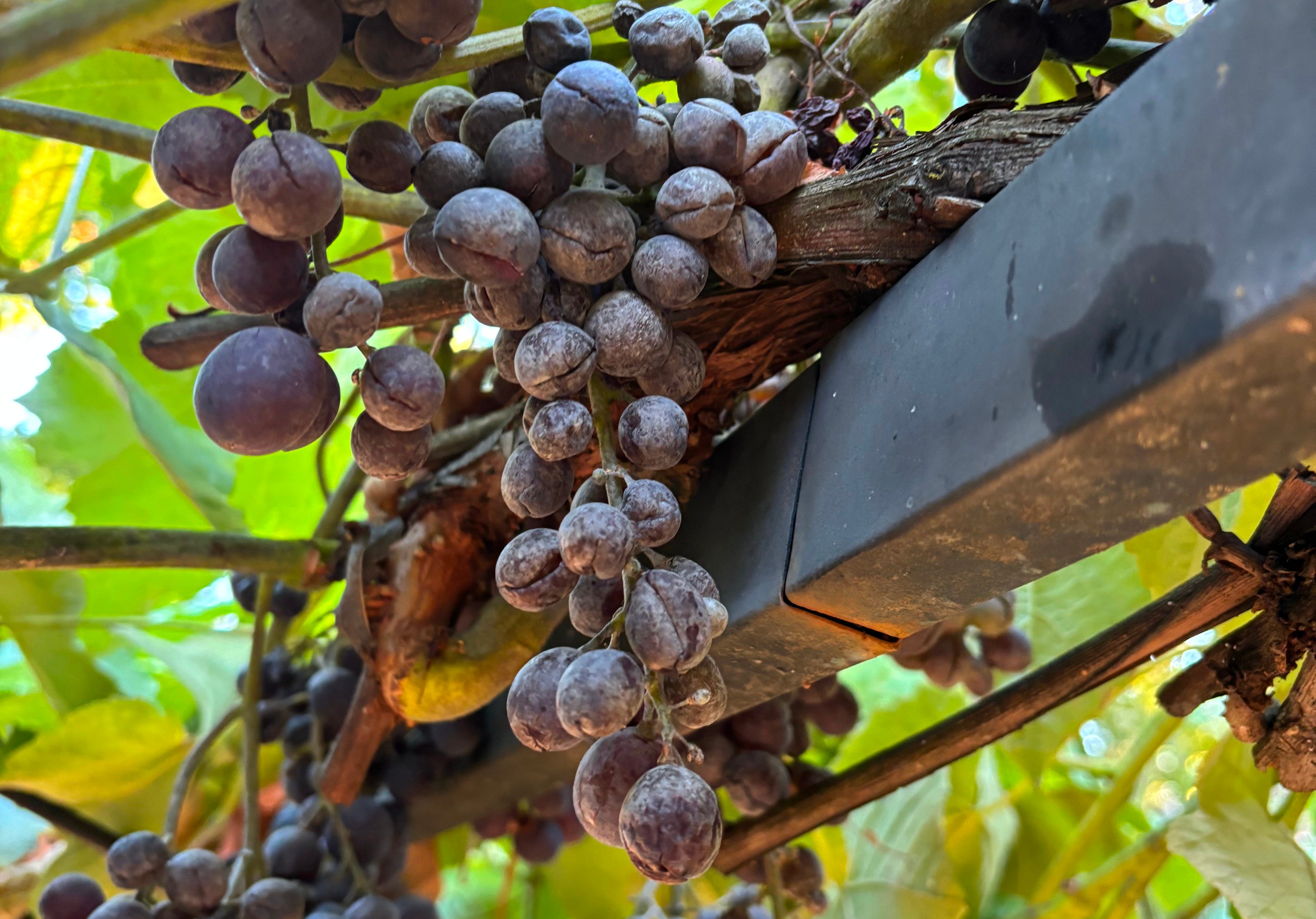
(Note: It’s been way too long since I shared anything here, and I apologize for that. I still don’t know what I want Substack to be, but I do know I need to be more consistent if I want to discover that through the writing. So, here’s posting in the hopes I’m more regular with the writing and sharing.
Thank you for reading.)
I tried this year, Lord—I really did—but the grapes didn’t make it. Who knew powdery mildew could be such a pestering, festering thing? I pruned as best I knew how, and I watered as best I knew how, but the mildew withered the grapes all the same.
I’m sad about the grapes because two years ago, I made raisins with them and so help me they were the best raisins I’d ever had. I offered them to anyone who came over the house, whether they were hungry or not.
“How was traffic? What was work like? Would you like some raisins? I made them myself.”
I’m sad about the grapes because I wanted to mash ‘em up and slide ‘em over to my ten-month-old daughter as if I was passing her an ace-king combo for blackjack.
I’m sad about the grapes because I loved watering them and I’ve enjoyed learning what it means to garden, and I like what gardening has done to me as a person, but I’m still so new to the whole thing and I’m struggling to accept that not everything goes as planned or hoped.
I’m tempted, Lamb, to turn this story into a simile or a metaphor for something else in order to spiritually bypass some of my deeper, more knotted feelings.
“Oh, the withered grapes are like the parable of the sower,” or maybe, “These grapes are the idols in my life that I pursue and how God does such and such and blah blah blah...”
If I took enough time, maybe one of those metaphors I’d come up with would be true. But at this moment, neither element of speech is helpful, because I’m not looking for similes or metaphors.
I’m looking for you.
I grew up in your house, O God, and that house was stuffed to the gills with metaphor. We used grape juice as a substitute for wine whenever we took communion, which my church viewed as a metaphor (no transubstantiation here, thank you very much) for your body and blood.
As a child, I was told I was “a soldier in the Lord’s army,” and that the big, bright invisible Jesus “lived in my heart,” and that the whole church was referred to as, “The bride of Christ,” or simply, “The Body,” as if all two-thousand-plus people could Voltron ourselves into one veiled mass for our tall, dark and handsome savior.
I’m not saying metaphor can’t ever be helpful, because sometimes it’s the only thing that helps me process tragedy or describe wonder. I’m not against metaphor—just here. Just now.
I don’t want you to be the vine, and I don’t want to be the branches. I want you to be Jesus, and I want me to be Dom.
What I’m trying to say is I don’t know what to do with a diseased harvest. I don’t know what to do with the feeling of having loved something, having devoted time and attention to it over and over, having believed in it and hoped for it and dreamt for it…and to have that thing die anyway.
Put another way, my affections didn’t guarantee its thriving—in fact, it’s possible said affection might have contributed (even unknowingly) to the fruit’s condition.
I don’t know, and I don’t know what to do with the not-knowing.
Today, God, I don’t want you to be like an egg or like the wind. I want you to be sad with me—on your knees, your hands holding mildewed and brittle clusters, matching my breath as I take in life amidst my dying.
I want you next to me as I take in the harvest of withered grapes, of friendships and estrangements and brilliant cosmos, of sore backs and heat waves and teething, of gray hair and waffles and stuffed animals and soil beneath my fingernails, amen and amen and amen.